
Junior
Guided exploration of everyday phenomena, with an emphasis on careful observation.
What the Raman Young Science Innovator stands for, where it comes from, and how it works, in detail.
RYSI exists to put the experience of real science within reach of every school student in India. We want children to feel the thrill of asking a question no one has answered for them, building something to test it, and being surprised by what they find.
Examinations measure what a student can recall. RYSI measures something harder and more valuable: whether a student can observe carefully, reason from evidence, and keep going when an experiment does not behave. These are the habits of mind that serve a young person for life, whether or not they become a scientist.
An experiment, not an exam. We reward original thinking over memorisation.
The programme is named after the physicist whose curiosity, sharp observation and simple apparatus changed how the world sees light.
The programme is named after Sir Chandrasekhara Venkata Raman, the Indian physicist who, with Sir K.S. Krishnan, in 1928, discovered that light scattering off molecules changes colour in a way that reveals the molecule itself, now known as the Raman Effect. The discovery earned him the Nobel Prize in Physics in 1930, the first awarded to an Asian scientist and still the only one in science awarded to an Indian.
What inspires us most is not only the discovery but how it was made: with simple apparatus, sharp observation and relentless curiosity. India marks the date of that discovery, 28 February, as National Science Day every year. RYSI carries that same spirit into the classroom.
Raman and Krishnan show that light scattering off molecules shifts colour, revealing the molecule itself.
The first Nobel Prize in the sciences awarded to an Asian scientist.
India marks the date of the discovery every year, the spirit RYSI carries into the classroom.
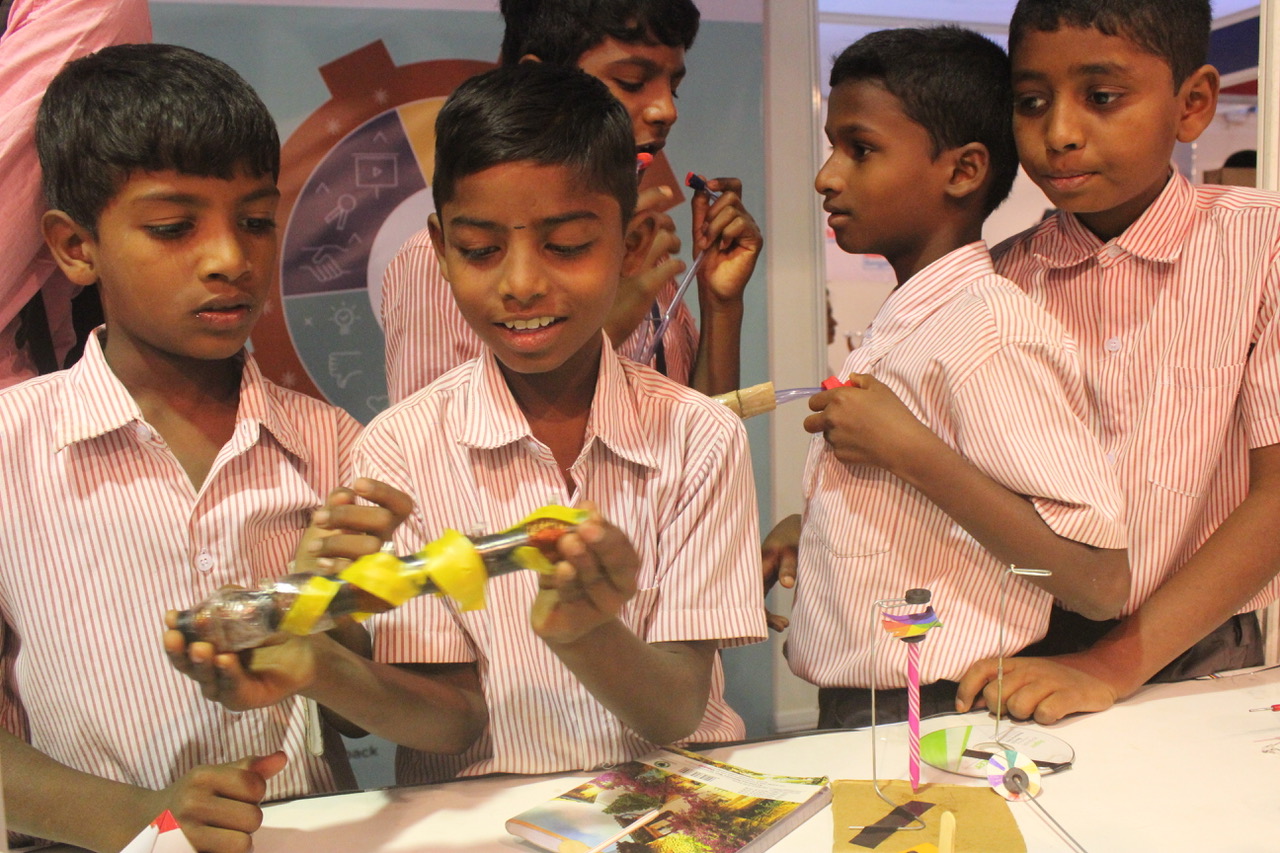
Five commitments that shape every season of the programme.
Students compete only against peers at a similar stage of learning, so expectations are matched to age.
Guided exploration of everyday phenomena, with an emphasis on careful observation.
Designing fair tests and beginning to explain results in terms of cause and effect.
Framing a hypothesis, controlling variables and presenting findings with early-research rigour.
Any school student in grades 3 to 10 may take part. Students compete in one of three categories: Junior (grades 3–4), Intermediate (grades 5–7) or Senior (grades 8–10), based on their current grade.
There is no fee for the Raman Awards. It is free to participate for any child studying in grades 3 to 10 in India.
Students can be entered through their school or independently. Begin on the registration page. Schools entering several students can use the bulk-upload format available in our resources.
RYSI runs in stages: students register and submit a pre-determined project online in Stage 1; qualifying students advance to Stage 2; in Stage 2, students submit up to two innovations of their choice and shortlisted students are invited to the national finals. See the full process and the schedule.
In Stage 1, a student is given an activity to work on, complete an observation sheet and quiz related to the activity and submit these plus a few photographs and a video on the portal. Selected students then move on to Stage 2. Here, a student can submit up to two innovations of their choice, through which they carry out a hands-on experiment, and submit their work online, typically a written account of their innovation, method, observations and conclusions, supported by photos and a short video of the experiment. We provide a sample submission in the resources.
Registration opens in July or August, with the Stage 1 deadline in September and Stage 2 in November. Results are declared at the beginning of January, and the National Finals are held at Sir C.V. Raman’s old home in Bangalore on the first complete weekend of February every year. Exact dates for the current season are on the schedule page.
Yes. Qualifiers and finalists are recognised with certificates for taking part, and category winners and runners-up receive cash awards, trophies and an annual experiential-science programme subscription.
Our team is happy to help schools, parents and students. Reach out through the contact page and we will get back to you.
Still have a question? Start on the registration page, browse our resources, see the full process and schedule, or contact the team.
Enter a student, or get your school involved this season.